
Electronic Warfare
- [Electronic Warfare - US Department of Defense]
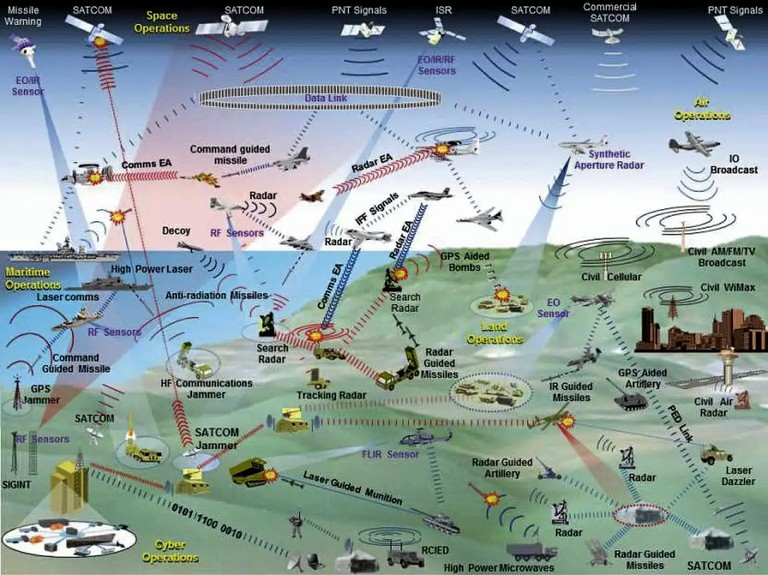
- Overview
Electronic Warfare (EW), highlighting its shift from traditional combat (swords/arrows) to invisible, technology-driven battles using electromagnetic spectrum control (radar, drones, cyber) for strategic advantage, enabling forces to detect, disrupt, or destroy enemy systems before physical engagement, a crucial element in modern, rapid conflicts.
Essentially, EW is about controlling the "invisible battlefield" of electronic signals and data, making it fundamental to contemporary military operations, as seen in conflicts like those in Ukraine.
EW can be applied from air, sea, land, and space by manned and unmanned systems.
- Evolution of Warfare: From physical weapons (swords, arrows) to electronic means (drones, radars).
- Definition of EW: Using the electromagnetic (EM) spectrum (radio, infrared, etc.) and cyber tools for military/intelligence missions.
- Goal of EW: Gaining an advantage by disrupting enemy C4ISR (Command, Control, Communications, Computers, Intelligence, Surveillance, and Reconnaissance) while protecting one's own.
- Modern Tools: Drones, RCIEDs (Radio-Controlled Improvised Explosive Devices), jammers, radar systems, and integrated cyber capabilities.
- Operational Impact: Starting battles invisibly, jamming communications, blinding sensors, and creating critical advantages in air, sea, land, and space.
- Key Advantage: Preempting threats and dealing with attacks electronically, offering speed and surprise.
2. EW techniques:
- Radio and microwave frequencies for satellites, radars, and communications
- Infrared for enemy targeting and intelligence gathering
- Electro-optical, infrared, and radio frequency countermeasures
- EM compatibility and deception
- Radio jamming, radar jamming and deception
- Electronic counter-countermeasures (or anti-jamming)
- Electronic masking, probing, reconnaissance, and intelligence
3. Why It's Critical:
- Ubiquity: All modern systems (drones, comms, weapons) rely on the EMS, making it a vital domain for control.
- Strategic Advantage: Allows forces to see, communicate, and maneuver better than the enemy, or prevents the enemy from doing the same.
- Silent Operations: Many EW systems operate covertly, neutralizing threats without being detected.
Please refer to the following for more information:
- Wikipedia: Electronic Warfare
- The Growing Importance of Electronic Warfare
Electronic Warfare (EW) is crucial because it controls the invisible electromagnetic spectrum (EMS) - the backbone of modern military operations - ensuring friendly forces can communicate, navigate, and target effectively, while simultaneously jamming, deceiving, or denying adversaries these vital capabilities, creating decisive advantages before a shot is even fired.
It enables battlefield superiority by protecting friendly systems, disrupting enemy sensors (radar, GPS), enhancing cyber defense, and acting as a low-cost "force multiplier" to preserve kinetic assets for high-value targets.
In essence, controlling the EMS through Electronic Warfare is fundamental to modern dominance, impacting everything from strategic objectives to tactical engagements, making it as vital as land, sea, and air power.
Key Reasons for EW's Importance:
- Control of the Spectrum: Modern militaries rely on the EMS for everything from radios and GPS to satellites; EW ensures access for friendly forces and denies it to enemies.
- Situational Awareness: EW helps build a clearer picture of the battlefield by detecting enemy electronic emissions, enhancing intelligence, surveillance, and reconnaissance (ISR).
- Disruption & Deception: EW can jam communications, spoof GPS signals to misdirect forces, and create decoys, rendering enemy systems ineffective or misleading them.
- Force Protection: By jamming enemy missiles or drones and disrupting command & control, EW protects troops and assets from harm.
- Enabling Operations: It allows stealth aircraft to operate unseen, synchronizes complex joint operations, and makes traditional weapons more effective.
- Strategic Deterrence: A strong EW posture deters technologically advanced adversaries by showing an ability to fight and win in the electronic domain.
- Cost-Effectiveness: EW provides non-kinetic effects, offering "unlimited rounds" to divert threats at a lower cost than physical weapons.
- Dual Use of Military EW and Civilian Sectors
The relationship between military Electronic Warfare (EW) and civilian sectors: while EW's core mission is military control of the electromagnetic spectrum (EMS) for attack/defense, its underlying tech (spectrum sensing, jamming techniques, stealth, signal analysis, AI-driven cognitive systems) heavily influences civilian areas like secure 5G, anti-drone tech, medical imaging, and even anti-fraud systems, enhancing security, data integrity, and awareness in commercial/healthcare settings.
In essence: EW creates the "rules of the road" for the spectrum; while military EW controls the road for war, the technology of road-building (spectrum management, signal processing) benefits everyone, including health and commerce, by making systems more robust, secure, and efficient.
Here's how EW principles translate:
- Spectrum Sensing & Analysis: EW's ability to map and understand the EMS for military advantage leads to better spectrum management for 5G, Wi-Fi, and radar, preventing interference in busy civilian environments.
- Jamming & Anti-Jamming: Techniques used to disrupt enemy comms (jamming) are adapted for civilian anti-drone systems (protecting events/airports) and to secure critical data links from interference.
- Stealth & Low Observability (EM Hardening): Military efforts to reduce electronic signatures inform designs for secure medical devices and data systems to prevent eavesdropping.
- Cognitive EW (AI/ML): The development of AI to rapidly identify and counter novel threats in EW is directly applicable to detecting sophisticated cyber threats in healthcare or financial systems.
- Precision Geolocation: Accurate positioning from EW systems helps develop precise location services (GPS-denied areas) for logistics, emergency response, and autonomous vehicles.
- Electronic Warfare and The Eelectromagnetic Spectrum
Electronic Warfare (EW) uses the Electromagnetic Spectrum (EMS) - radio waves, light, etc. - to control the battlefield by supporting friendly forces (GPS, comms) and denying enemies use of the spectrum through jamming or deception, protecting assets and gathering intel, essentially making the invisible battlefield visible and controllable for military advantage.
It involves Electronic Support (ES) to find signals, Electronic Attack (EA) to disrupt them (like jammers), and Electronic Protection (EP) to shield own systems, all crucial for modern land, sea, air, and space operations.
A. Key Concepts:
1. Electromagnetic Spectrum (EMS): The range of all electromagnetic waves, from radio to gamma rays, used for everything from Wi-Fi and GPS to radar and satellite communication.
2. Electronic Warfare (EW): Military actions to control the EMS for advantage, encompassing three main areas:
- Electronic Support (ES): Detecting, intercepting, and locating enemy signals (radar, comms).
- Electronic Attack (EA): Disrupting, jamming, or deceiving enemy systems (e.g., RCIED jammers).
- Electronic Protection (EP): Protecting friendly systems from enemy EW (e.g., frequency hopping, stealth).
B. How EW Works in Conflict:
- Sensing & Support (ES): Systems like ESM (Electronic Support Measures) listen for enemy emissions to build an intelligence picture.
- Access & Attack (EA): Jammers prevent enemy drones or radios from working; SIGINT (Signals Intelligence) intercepts and decodes enemy comms.
- Protection & Maneuver (EP): Ensures friendly forces maintain their critical GPS, communication, and targeting links.
- [The electromagnetic spectrum from lowest energy/longest wavelength (at the top) to highest energy/shortest wavelength (at the bottom). (Credit: NASA's Imagine the Universe)]
- History and Future of Electronic Warfare
Electronic Warfare (EW) evolved from early signal jamming in the Russo-Japanese War (1904) and WWI to become central in WWII ("Battle of the Beams") with radar/jamming, maturing through the Cold War's massive Soviet censorship and Vietnam's air tactics, leading to today's spectrum dominance focus.
The future of EW is defined by AI integration, cyber warfare, space assets, ubiquitous sensors, and adapting to cheap, widespread drones, requiring constant, rapid innovation for spectrum superiority, blurring lines with cyber and space domains, and impacting everything from GPS to autonomous systems.
A. History of Electronic Warfare:
1. Early Beginnings (Pre-WWII):
- 1904: Russians jammed Japanese naval comms at Port Arthur.
- WWI: Jamming and spoofing of German Zeppelin navigation signals.
- Boer War (1899-1902): British used searchlights to bounce Morse code; Boers jammed them.
2. World War II: The "Battle of the Beams," massive use of jamming (ECM) and electronic support measures (ESM) against radar and communications, and the development of stealth tech.
3. Cold War: Huge Soviet jamming of Western broadcasts (1950s-80s); Vietnam War saw major air tactics adapt to EW.
4. Modern Era: Integration of GPS, UAVs, and cyber tools; proving dominance is critical in Gulf War and beyond.
B. Future of Electronic Warfare:
1. Key Trends:
- AI & Big Data: Real-time processing for faster detection and decision-making.
- Cyber-EW Convergence: Full integration of cyber and electronic capabilities.
- Space Dominance: Relying on and denying space-based EW/GPS assets.
- ** Ubiquitous Sensors:** Cheaper sensors make stealth harder, shifting power to "seekers".
- ** Counter-Drone Tech:** Adapting to cheap, numerous drones (e.g., Ukraine conflict).
2. Challenges:
- Rapid Evolution: Constant threat changes require faster innovation than traditional defense cycles.
- Proliferation: Lower cost means more actors (smaller nations, non-state) can use EW.
- Ethical Concerns: Autonomous systems and data use raise legal/ethical questions.
3. The Goal: Maintain "spectrum superiority"—control of the electromagnetic spectrum for friendly forces while denying it to the enemy—remains paramount, now with more complex, integrated tools.
- Modern EW Technology and Systems
Modern Electronic Warfare (EW) is rapidly evolving through the integration of AI, Machine Learning (ML), and cyber warfare, creating powerful offensive/defensive systems that analyze the electromagnetic spectrum (EMS) to detect threats, spoof enemies, and protect forces, moving beyond simple jamming with cognitive systems that learn and adapt, enabling seamless operations across domains like air, land, sea, and cyber for total information dominance.
1. Key Innovations in Modern EW:
- Cognitive Systems & AI/ML: Cognitive EW uses AI to learn, reason, and predict, rapidly detecting new threats, creating countermeasures, and assessing battle damage, replacing slow, manual methods.
- Integration of Cyber & EW (ECIW): A major trend is the fusion of Electronic, Cyber, and Information Warfare (ECIW) for unified offense and defense, disrupting enemies in the digital and physical realms.
- Software-Defined Systems: Utilizing commercial tech for software-defined military operations offers scalability and faster adaptation to evolving threats.
- Advanced Hardware: Innovations include wideband digital receivers, digital radio frequency memory (DRFM), and FPGA-based systems for better signal processing and EW capabilities in platforms like drones.
2. Offensive & Defensive Capabilities:
- Detection & ISR: Using sensors to identify enemy vehicles and communications across the EMS for intelligence, surveillance, and reconnaissance (ISR).
- Protection & Deception: Jamming, spoofing, masking, and creating electronic decoys to protect friendly forces and deceive adversaries.
- Cyber-Enabled Offense: Digital attacks crippling enemy systems, coordinated with physical strikes for maximum impact.
- Counter-Hacking: Integrated solutions to defend against sophisticated information hacking techniques.
3. Impact on Warfare:
- Shift in Tactics: The convergence of cyber and EW necessitates new tactics, moving away from fragmented specialist roles to unified, multi-domain operations.
- Electromagnetic Spectrum Dominance: The goal is to control the EMS, denying adversaries its use while leveraging it for advantage.
- Next-Gen Networks: Future networks (like 6G) will enhance tactical connectivity, enabling more secure and autonomous operations.
- Fifth Generation Warfare
Fifth Generation Warfare (5GW) is a modern concept of conflict focused on information, perception, and social manipulation, rather than traditional kinetic (physical) force, using tools like cyberattacks, disinformation, and AI to destabilize societies from within, blurring lines between war/peace and combatant/non-combatant.
It's a data-driven, non-kinetic approach that exploits cognitive biases to achieve political goals, often without overt military action or even public awareness that a conflict is happening.
1. Key Characteristics:
- Non-Kinetic Focus: Avoids direct military clashes, targeting minds and behaviors instead of physical infrastructure or armies.
- Information & Perception: A "war of information and perception" where reality is manipulated through media, social engineering, and propaganda to influence public opinion and actions.
- Emerging Technologies: Leverages AI, cyber warfare, autonomous systems, and biotechnology to spread influence and sow discord.
- Decentralized & Blurry: Power is distributed, allowing non-state actors to have significant impact, and the battlefield is omnipresent (online/offline), making attribution difficult.
- "Hybrid" Nature: Blends traditional military concepts with new digital and psychological tools, creating an integrated, continuous conflict.
2. Tools & Tactics:
- Social Engineering & Misinformation: Spreading fake news and propaganda via social media to create societal divisions and undermine institutions.
- Cyberattacks: Hacking infrastructure or data to disrupt services and sow chaos.
- Psychological Operations (PsyOps): Targeting human minds and biases for desired outcomes.
3. Impact:
- Perpetual Conflict: Nations can remain in a state of constant, low-level conflict without open war.
- Undermining Sovereignty: Enables external actors to interfere with internal affairs, challenging national security.
- Lack of Awareness: The target population often doesn't know they are being attacked, making defense difficult.
[More to come ...]
