
The Past, Present, and Future of LTE
- [3GPP Release 12 and Beyond]
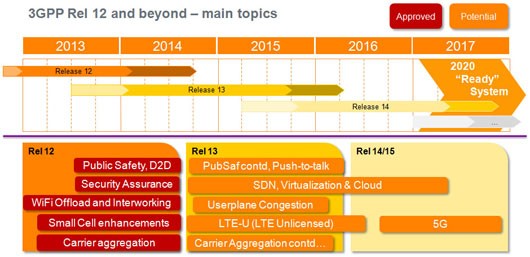
LTE Evolution - The Long Run To 5G
- Overview
LTE's past includes its first commercial deployment in 2009 and initial releases that brought faster mobile internet. In the present, LTE is still the backbone for most mobile connectivity, providing high-speed data, HD voice, and a stable connection for a wide range of devices and applications, even as 5G networks are built out.
The future of LTE is one of gradual sunsetting, as operators (carriers) reallocate its spectrum for 5G, with most LTE services expected to be decommissioned by 2035, though it will continue to coexist with 5G in the interim.
Expect LTE to become less reliable and slower over the next few years as 5G expands, with a final, sharp cut-off for most non-5G devices occurring in the mid-to-late 2030s.
1. Past: The foundations of high-speed mobile internet:
- First commercial deployment: LTE, or Long Term Evolution, was first commercially deployed in December 2009 by TeliaSonera, marking the beginning of the 4G era.
- Initial releases: Early versions, like Release 8, established high peak data rates (up to 300Mbps downlink) and improved spectral efficiency compared to older 3G technologies.
- Evolution to LTE-Advanced: Later versions, such as LTE-Advanced (Rel-10 and beyond), introduced new features like carrier aggregation to combine multiple bandwidths, enhanced multi-antenna support, and higher-order modulation schemes like 256-QAM to further boost speeds and efficiency.
2. Present: A stable and widespread network:
- Widespread coverage: LTE is nearly ubiquitous, providing reliable connectivity in urban and rural areas where 5G is not yet available.
- Foundation for modern apps: Its high speeds and low latency handle data-intensive applications like video calling, streaming, and online gaming, supporting everything from smartphones to tablets and smartwatches.
- Coexistence with 5G: Many operators are running both LTE and 5G networks simultaneously, with LTE serving as a fallback for users outside 5G coverage areas.
- Supporting specific needs: Specialized LTE technologies like LTE-M and NB-IoT continue to be used for low-power, low-data-rate Internet of Things (IoT) devices.
3. Future: Transition and decommissioning:
- Gradual shutdown: As 5G deployment accelerates, operators are reallocating LTE spectrum to build out their 5G networks.
- Sunset timeline: Some operators plan to phase out their LTE services, with estimates suggesting that most LTE channels could be shut down by 2028 and a full shutdown nationwide by around 2035.
- Interim period: In the years leading up to the final shutdown, LTE will continue to serve as a critical fallback network for 5G devices and will coexist with 5G networks for a considerable time.
- Continued evolution: The technology continues to be relevant in niche applications and is seen as a stepping-stone to 5G, with technologies like 5G RedCap building on LTE concepts to serve moderate-bandwidth IoT devices.
- LTE Standardization and Deployment
LTE (Long Term Evolution) rapidly became the fastest-growing cellular technology due to the standardization efforts of 3GPP, which allowed for quick market adoption and widespread deployment, marking a significant milestone in mobile communication history by bringing the entire industry together under a single technology footprint.
1. Key characteristics about LTE standardization and deployment:
- 3GPP's crucial role: The Third Generation Partnership Project (3GPP) standardized LTE, enabling rapid development and global adoption of the technology.
- Unprecedented market penetration: LTE achieved faster market penetration than any previous radio technology thanks to its standardized framework.
- Focus on enhancements: After the initial release, 3GPP continued to improve LTE standards through subsequent releases, focusing on capacity, performance, and accessibility for new business segments.
- Scalability for growing traffic: Important advancements in LTE standards were aimed at handling the exponential growth in smartphone data traffic, particularly with the introduction of features like enhanced capacity and improved handover mechanisms.
2. Important areas of focus in LTE evolution:
- Enhanced radio standards: Improving LTE radio technology to further increase capacity and data speeds.
- System standard enhancements: Expanding LTE and EPC (Evolved Packet Core) availability to cater to new business segments and applications.
- Robustness improvements: Addressing the challenges posed by increasing smartphone traffic, including better network handling and handoff mechanisms.
- LTE Standards
LTE (Long-Term Evolution) is a global wireless standard based on a flat, all-IP core network architecture known as SAE, which uses OFDMA for modulation and MIMO for multiple data streams.
The 3GPP developed LTE in its Release 8, with subsequent releases enhancing features like carrier aggregation, advanced MIMO, and massive MIMO.
A. Key components and characteristics:
- Core Network: The System Architecture Evolution (SAE) is the core network that is a flat, all-IP architecture with a separation of control and user traffic.
- Modulation: It is based on the OFDMA (Orthogonal Frequency-Division Multiple Access) digital modulation scheme to support high data rates.
- MIMO: Multiple-Input-Multiple-Output (MIMO) uses multiple antennas on both the network and user equipment (UE) to deliver and receive multiple data streams simultaneously. An example is a 4x2 MIMO, where the network has four transmitting antennas and the UE has two receiving antennas.
- Channel Bandwidth: LTE supports channels with bandwidths up to 20 MHz.
B. Evolution of the standards:
1. 3GPP Release 8: This is where the initial LTE standard was developed.
2. Releases 9, 10, and 11: These releases introduced key enhancements such as:
- Carrier Aggregation
- Advanced MIMO techniques
- Enhanced downlink control channel
3. Release 12: This release further improved LTE with additional enhancements, including:
- Massive MIMO and beamforming
- FDD/TDD carrier aggregation
- Enhanced small cells and heterogeneous networks
- The Gradual Shutdown of 4G LTE
The gradual shutdown of 4G LTE is effective for carriers to repurpose spectrum for faster 5G, but it's a slow process that gradually degrades LTE performance as bands are reallocated, eventually leading to a full shutdown, much like the Hemingway quote: "gradually, then suddenly," leaving 5G as the primary network for the future.
While LTE remains crucial for coverage for years, users with older devices might notice reduced speeds or connectivity issues as bandwidth shrinks, with some network operators (carriers) planning to fully decommission LTE by 2035.
1. How it Works (Gradual Phase-Out):
- Spectrum Refarming: Carriers like T-Mobile reallocate frequency bands (like LTE Bands 2, 4/66, 12) from 4G LTE to 5G, boosting 5G capacity.
- Performance Degradation: As bandwidth shrinks, LTE coverage and performance slowly diminish for users, creating a "soft shutdown" effect before the final switch-off.
- Coexistence: 4G LTE and 5G will coexist for a significant period, with LTE supporting areas without 5G and older devices, but 5G becomes the priority.
2. Effectiveness:
- For Carriers: Highly effective for modernizing networks, increasing 5G capacity, and reducing infrastructure costs by consolidating networks.
- For Users: Effective in the long term for better 5G speeds, but users with older LTE-only devices may experience a gradual decline in service quality or need to upgrade.
3. What to Expect:
- Reduced LTE Footprint: A narrow sliver of LTE will remain, primarily for fallback and older devices.
- 5G Standalone (SA) Focus: Carriers will push for activations on 5G SA networks.
- Eventual Full Shutdown: The process culminates in the eventual, more decisive switch-off of the entire LTE network, similar to past 2G/3G shutdowns.
- The "Gradually and then Suddenly" Prognosis for LTE Switch-off
The "Gradually and then suddenly" prognosis for LTE switch-off means carriers will slowly refarm spectrum from 4G to 5G for efficiency, but a full shutdown won't happen overnight; instead, it's a longer, phased process, with some carriers starting early decommissioning (expect most LTE gone by 2028, fully by 2035), while others plan for LTE to last well into the 2030s, especially as it remains crucial for many IoT devices, creating a gradual decline followed by a final, rapid cessation for legacy devices.
1. The Gradual Phase (Now to ~2030s):
- Spectrum Refarming: Carriers need space for 5G, so they're slowly reclaiming 4G frequencies, making LTE less robust for some users.
- IoT Dependency: Many IoT devices (like sensors, payment terminals) rely heavily on LTE, preventing an immediate shutdown, as 5G isn't always a direct replacement for their needs.
- Carrier-Specific Timelines: T-Mobile is leading, planning to significantly reduce LTE by 2028 and fully shut down by 2035, while other US carriers aim for a longer coexistence, around 2030 or later.
2. The Sudden Phase (~2030s & Beyond):
- "Soft Shutdowns": As spectrum shrinks, LTE performance will degrade, creating "soft shutdowns" for older LTE-only devices, meaning they'll struggle or stop working effectively.
- Device Obsolescence: Devices not supporting 5G will eventually become unusable as networks fully transition, mirroring past 2G/3G sunsets.
- Future-Proofing: Companies deploying IoT today plan for 5G's long-term viability, recognizing LTE's eventual end-of-life, even if it's currently adequate.
[More to come ...]
