Modern Data Center and Networking
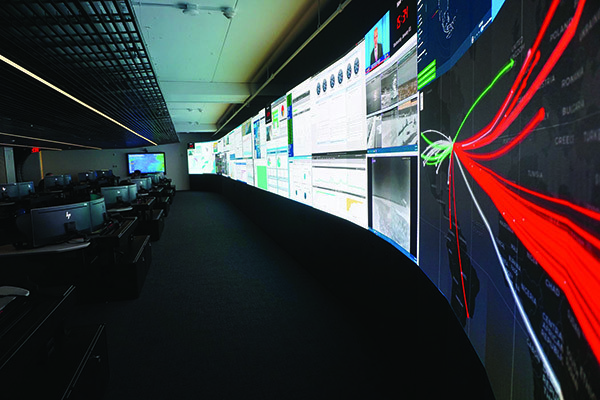
- (The New York Power Authority’s Integrated Smart Operations Center (iSOC))
- Overview
Digital transformation integrates digital technology into all organizational areas, fundamentally changing how businesses deliver value. Today, this evolution demands agile, software-defined networks and automated security to meet hyper-connected, global user expectations and handle unprecedented data workflows.
A modern data center and its networking infrastructure represent the shift from rigid, physical hardware to agile, software-defined environments. It combines on-premises, cloud, and edge facilities using automation, virtualization, and advanced fabrics to dynamically route traffic and securely support global, high-performance computing workloads.
1. Key Characteristics & Technologies:
- Software-Defined Networking (SDN): Replaces manual hardware configurations with centralized, software-based network management, allowing administrators to provision policies and manage traffic flexibly from a single pane of glass.
- Spine-and-Leaf Architecture: Replaces traditional multi-tier topologies with a flattened "Clos" design. Every leaf switch connects directly to every spine switch, creating highly redundant, low-latency paths for traffic moving across servers ("east-west" traffic).
- Virtualization & Overlay Networks: Abstracts the network from physical limits, running network services entirely in software. Technologies like EVPN-VXLAN create virtual overlays that span across multiple physical and cloud environments.
- Intent-Based Networking (IBN): Uses automation and analytics to automatically translate business intent into network configurations, shortening deployment times and preventing outages.
- Zero-Trust Security & Microsegmentation: Implements strict, granular security policies inside the data center itself, ensuring workloads are isolated and threats are contained even if the perimeter is breached.
- DPUs (Data Processing Units): Advanced, purpose-built silicon offloads compute-intensive networking, security, and storage tasks from the CPU to accelerate performance and free up resources for heavy workloads like artificial intelligence.
2. Why the Shift Matters:
- Scalability: Organizations can rapidly scale network, storage, and compute demands to adapt to business changes.
- Automation: Replaces error-prone manual provisioning with automated deployment and self-healing systems, reducing the burden on networking staff.
- Agility: Applications and data can be moved seamlessly between physical data centers, edge locations, and multi-cloud environments.
- Digital Transformation and The Future of the Networks
Digital Transformation can be described as the changes associated with the application of digital technologies in all aspects of business and society. Today, Digital Transformation extends much further and far deeper into the organization, crossing and intersecting with a great many more business functions, processes and boundaries. And with the increase in mobile connectivity, social media, cloud computing and big data analytics, organizations need new ways of dealing with the customer experience and market opportunities.
Digital transformation, largely driven by the demands of the user experience, will redefine networking and security. Securing networks will be propelled by machine learning (ML) and artificial intelligence (AL). Unlike today’s network security systems - largely human administered and maintained - ML and AI will be constantly vigilant against threats and vulnerabilities.
The content on networks today and changing consumption models are shifting requirements for the network.
In Today’s constantly evolving, on-demand world, the network still needs to scale for massive capacity growth, but it now also needs to be more agile and programmable to better respond and handle unpredictable traffic requirements associated with cloud connectivity and the proliferation of mobile devices.
The Internet of Things (IoT) and hyper-connectivity will fundamentally disrupt traditional networking and security safeguards.
As customers are now typically global, data workflows have become ever more complex and applications increasingly more sophisticated, the network infrastructure therefore has to prevent any disconnect throughout the organization, especially in terms of access to data or operational processes across the business, or regional boundaries.
1. The shift to dynamic networks:
The shift from rigid, human-administered systems to dynamic networks is restructuring IT architectures across several core areas:
- AI & ML-Driven Security: Machine learning (ML) and AI are replacing manual safeguards to provide constant, real-time threat vigilance.
- Agility and Programmability: Networks are evolving to scale massively while dynamically routing the unpredictable traffic associated with cloud computing.
- Seamless Global Connectivity: To prevent disconnects across regional boundaries, organizations rely on complex data workflows that operate consistently worldwide.
2. Exploring the Future of Networking:
Modern digital strategies require continuous organizational shifts in culture, processes, and technology models to succeed. Consider these resources to further understand how networking is adapting:
- Strategic Perspectives: Review the OECD Digital Transformation policies for global, macro-level insights on how digital adoption transcends national borders.
- Cloud Architecture: Explore Cloudflare Digital Transformation for educational resources on how to shift legacy operating models to modern, scalable platforms.
- Business Strategy: Read the IBM Digital Transformation guide to see how modern organizations modernize their technology stacks to enable continual, customer-driven innovation.
- Future Trends in Networking
The future of networking is moving toward highly intelligent, autonomous, and distributed systems. Beyond the general rollout of 5G, the industry is already transitioning to 5G-Advanced and looking toward 6G, where artificial intelligence (AI) is integrated into every layer of the network architecture to handle the exponential growth of data and connected devices.
(A) Core Technological Shifts:
- 5G-Advanced and 6G: While 5G is reaching near-universal adoption in regions like North America, the next phase (5G-Advanced) focuses on energy efficiency, precise positioning, and integration with satellites and drones. 6G, expected around 2030, aims for "pervasive intelligence" with speeds potentially 100 times faster than 5G.
- AI-Native Networking: Networking is shifting from manual management to AI-RAN (Radio Access Network). This means AI/ML algorithms manage radio frequency bands, optimize traffic, and perform "self-healing" to fix network issues autonomously in real-time.
- Edge AI Convergence: Processing is moving away from centralized data centers to the network's "periphery." Edge AI runs machine learning models directly on local devices or edge servers, enabling sub-5ms latency for critical tasks like autonomous driving and real-time industrial robotics.
(B) Key Strategic Trends:
1. Network Slicing: This allows operators to create multiple virtual networks on a single physical 5G infrastructure, each customized for specific needs—such as a high-security slice for healthcare or a high-bandwidth slice for 8K video streaming.
2. Advanced Cybersecurity: The massive increase in IoT devices and AI agents expands the "attack surface." Future security relies on Zero Trust architectures and AI-driven threat detection to counter sophisticated ransomware and automated cyberattacks.
3. Programmable and Intent-Driven Networks: Networks are becoming software-defined, where operators set a "desired outcome" (e.g., "prioritize emergency traffic") and the network automatically configures itself to meet that goal.
4. Emerging Connectivity:
- Wi-Fi 7: The next standard (802.11be) is emerging to provide ultra-high throughput and lower latency for home and office environments.
- Quantum Networking: Early research is exploring quantum communication to create virtually unhackable networks.
- Satellite Integration: A push toward "non-terrestrial networks" ensures seamless coverage even in remote or deep-sea areas.
- The Evolution of Data Centers
Infrastructure Is Everywhere - So Is Your Data. The role of I&O (intake and output) in the future will be to manage the global infrastructure and its associated services, moving away from only hardware and software. The end result will be an environment focused on enabling the rapid deployment of business services and deploying workloads to the right locations.
As technologies like AI and machine learning are harnessed as competitive differentiators, planning for how explosive data growth will be managed is vital. Today, most of enterprise IT infrastructures will focus on centers of data, rather than traditional data centers.
Due to integration and connectivity, colocation and/or cloud partner ecosystems will be critical for future infrastructures. All workloads are not equal, and proper placement is key to unlocking their true potential to the business.
Infrastructures are dynamic and must be able to change quickly, as markets and providers change Edge and IoT deployments are stretching infrastructures, shifting priorities and adding complexity.
The evolution of data centers refers to the historical progression of data storage and processing facilities, moving from large, dedicated mainframes in the early days to today's sophisticated, highly-scalable, and energy-efficient facilities that power the internet, driven by advancements in technology like virtualization, cloud computing, and increased data demands across industries.
Essentially mirroring the rapid development of computing power over time, with key milestones including the transition from mainframes to minicomputers, the rise of client-server architecture, and the adoption of cloud-based solutions.
Current trends in data center evolution:
- Edge Computing: Processing data closer to its source to reduce latency for real-time applications
- Sustainability Initiatives: Focus on energy-efficient cooling systems and renewable energy sources
- Artificial Intelligence (AI) Integration: Utilizing AI for data center management, optimization, and predictive maintenance
- Next Generation Data Center
For many years, data centers have been the center of tech operations for businesses of all sizes, whether they manage their own data centers or rely on data centers as a service from third-party vendors. In any case, data centers are evolving; thanks to advanced technology like cognitive computing and predictive analytics, today’s data centers are becoming smarter and more capable.
But what, exactly, does this mean for you and your business? Next generation data centers employ many new technologies, including:
- Software-defined control: Next generation data centers rely on software-defined technologies as their logical layer, allowing for better control of physical and virtual resources.
- Automation: One of the biggest priorities of a next generation data center is automation—streamlining workflows and reducing the burden of manual upkeep. Resources can be allocated dynamically, resulting in far greater efficiency and less room for error.
- Machine learning: Many high-tech data centers now employ the use of machine learning and cognitive computing to learn from real-time data and adjust their performance on the fly.
- Cloud + Data Center Transformation
"Cloud + Data Center Transformation" refers to the process of modernizing a traditional data center by migrating its operations and infrastructure to the cloud, allowing for increased scalability, flexibility, cost efficiency, and agility through utilizing cloud computing services like Infrastructure as a Service (IaaS), Platform as a Service (PaaS), and Software as a Service (SaaS), essentially moving away from managing physical hardware to utilizing a virtualized environment hosted on remote servers managed by a cloud provider.
Key aspects of "Cloud + Data Center Transformation":
- Migration to the Cloud: Moving applications, data, and systems from on-premise data centers to cloud platforms like AWS, Azure, or Google Cloud.
- Consolidation: Combining multiple data centers into a smaller footprint by leveraging cloud resources, potentially reducing hardware costs.
- Infrastructure Optimization: Utilizing cloud-based infrastructure management tools to automate and streamline data center operations.
- Software-Defined Infrastructure (SDI): Implementing software-based control of data center hardware, allowing for dynamic resource allocation.
- DevOps Integration: Integrating cloud services with DevOps practices to accelerate development and deployment cycles.
Benefits of "Cloud + Data Center Transformation":
- Cost Reduction: Pay-as-you-go model eliminates the need for large upfront investments in hardware and reduces maintenance costs.
- Scalability: Easily scale computing power up or down based on demand without the need for physical hardware upgrades.
- Flexibility: Access data and applications from anywhere with an internet connection.
- Improved Agility: Rapidly deploy new applications and services to market faster.
- Disaster Recovery: Enhanced data redundancy and resiliency through cloud-based backup and disaster recovery solutions.
Challenges of "Cloud + Data Center Transformation":
- Complexity: Managing diverse cloud services and migrating complex applications can be challenging.
- Security Concerns: Ensuring data privacy and security in a cloud environment
- Vendor Lock-in: Dependence on a single cloud provider can limit flexibility
- Legacy System Integration: Integrating older applications with cloud-based systems
- Data Center vs Cloud Computing
A data center is a physical building that houses all the hardware and infrastructure needed to store and process data, while cloud computing is a service that delivers computing resources like servers, storage, and software over the internet, essentially allowing access to a network of data centers managed by a third-party provider, providing scalability and flexibility without the need to manage physical hardware on-site.
In simpler terms, a data center is the physical building where the cloud infrastructure resides, while the cloud itself is the accessible service provided through the internet.
Cloud computing lives in data centers, and we use networks to get to it. The main difference between a cloud and a data center is that a cloud is an off-premise form of computing that stores data on the Internet, whereas a data center refers to on-premise hardware that stores data within an organization's local network.
While cloud services are outsourced to third-party cloud providers who perform all updates and ongoing maintenance, data centers are typically run by an in-house IT department.
Although both types of computing systems can store data, as a physical unit, only a data center can store servers and other equipment. As such, cloud service providers use data centers to house cloud services and cloud-based resources.
For cloud-hosting purposes, vendors also often own multiple data centers in several geographic locations to safeguard data availability during outages and other data center failures. When your data is stored on cloud servers, it automatically gets fragmented and duplicated across various locations for secure storage.
In case there are any failures, your cloud services provider will make sure that there is a backup of your backup as well!
Key differences:
- Control: With a data center, you have complete control over your hardware and infrastructure, while with cloud computing, you primarily access resources provided by a third-party cloud provider with limited customization options.
- Scalability: Cloud computing allows for easy scaling up or down of resources based on demand, whereas scaling in a data center usually requires purchasing and installing new hardware.
- Accessibility: Cloud services can be accessed from anywhere with an internet connection, while a data center typically requires physical access to the facility.
- Cost: Cloud computing often follows a pay-per-use model, meaning you only pay for the resources you use, while a data center involves upfront costs for hardware and maintenance even when not fully utilized.
- Beverly Hills, California - Civil Engineering Discoveries]
- On-Demand Computing in Cloud Computing
On-demand computing is a delivery model in which computing resources are made available to the user as needed. The resources may be maintained within the user's enterprise, or made available by a cloud service provider.
On-demand computing in cloud computing refers to a model where users can access computing resources like servers, storage, and software "as needed" through the internet, allowing them to scale up or down their usage based on demand, essentially paying only for the resources they utilize, without the need for large upfront investments in hardware or long-term contracts; it's often described as a "pay-as-you-go" model and is a key feature of cloud services.
Key features about on-demand computing:
- Flexibility: Users can quickly provision and deprovision resources depending on their current workload.
- Scalability: Businesses can easily scale up their computing power during peak usage periods and scale down when demand decreases.
- Cost-effective: Pay only for the computing resources used, eliminating the need for large upfront hardware investments.
- Self-service: Users can manage their computing resources through a web-based interface without needing extensive IT expertise.
Cloud computing is the on-demand availability of computer system resources, especially data storage and computing power, without direct active management by the user. The term is generally used to describe data centers available to many users over the Internet.
Cloud computing has become the ideal way to deliver enterprise applications—and the preferred solution for companies extending their infrastructure or launching new innovations.
Example of on-demand computing: A small business might use a cloud platform to access additional processing power during a busy sales period, then reduce usage during slower months.
- Three Types of Cloud Data Centers
We’ve all learned that cloud computing lives in data centers, and we use Internet to get to it. That’s a useful model, but the truth is that we’ve been using three kinds of cloud computing for years now, and Data center-based clouds are just the first type of cloud to reach mass adoption.
The next best-known type of cloud, the "overlay cloud", is spread across many data centers but functions independent of any one cloud. Overlay cloud is a software-based layer that sits on top of existing infrastructure, adding additional functionality like network management or security, without requiring significant hardware changes.
The least-known type of cloud is highly distributed on clients and devices and emerges from the ability of a single administrator to manage hundreds of thousands of devices from a single console. Highly Distributed Cloud on Clients and Devices (Edge Computing) refers to placing computing power closer to the source of data, like on personal devices or IoT sensors, enabling faster processing and reduced latency for geographically dispersed users.
Three primary types of cloud data centers are: public clouds, private clouds, and hybrid clouds; with "data center-based clouds" typically referring to the public cloud model, while "overlay clouds" are a type of distributed cloud that sits on top of existing infrastructure, and "highly distributed clouds on clients and devices" are considered edge computing, where processing power is distributed closer to the user on their devices.
- Public Cloud: This is a cloud service provided by a third-party vendor, where multiple organizations share the same infrastructure, accessible through the internet. Examples include Amazon Web Services (AWS), Microsoft Azure, and Google Cloud Platform (GCP).
- Private Cloud: A dedicated cloud infrastructure for a single organization, often hosted on-premises or in a dedicated data center, providing greater control over data and security.
- Hybrid Cloud: A combination of both public and private cloud services, allowing organizations to leverage the benefits of each depending on their needs.
