
Integration of PASPOC within the Deep Space Technology Ecosystem
- [Space Laser Communication - NASA]
- Overview
Physical AI, silicon photonics, and optical communications (PASPOC) are converging to form the foundational infrastructure for high-speed computation, autonomous robotics, and deep-space data routing.
1. Physical AI and Space-Era Systems:
- Embodied Intelligence in 3D: Physical AI connects generative AI (GenAI) models to autonomous machines and robots that must operate and make decisions in real physical environments rather than just processing data on a 2D screen.
- Space Engineering & Simulation: Physics AI combines high-performance simulation data with real experimental data to train autonomous spacecraft, rovers, and orbital infrastructure to handle unpredictable forces and harsh space environments.
- Overcoming the Data Bottleneck: Training and operating physical AI models require massive computational workloads and ultra-low latency decision loops, driving the demand for next-generation interconnects.
2. Silicon Photonics in Extreme Architectures:
- Replacing Copper with Light: Traditional copper connections suffer from massive signal loss and high power consumption at high speeds (e.g., 20 dB of loss over a single meter at 100 GHz and above). Silicon photonics uses light (photons) routed through microscopic silicon waveguides—which act as transparent glass at infrared laser frequencies—to transmit data with near-zero loss over long distances.
- Co-Packaged Optics (CPO): By placing optical engines directly next to processors (shrinking signal paths from centimeters to millimeters), CPO cuts optical connection power consumption by up to 84% and significantly reduces latency and system footprints.
- Heterogeneous Integration: Because silicon is poor at generating light, engineers bond tiny lasers made of specialized compound materials directly onto silicon chips, merging electrical computation with optical speed.
3. Optical Communications as the Backbone:
- High-Bandwidth Interconnects: Modern AI chips and distributed space-computing nodes generate and process tens to hundreds of terabits of data, requiring high-density scale-out and scale-up optical networks (scaling toward 1.6T and 3.2T data rates).
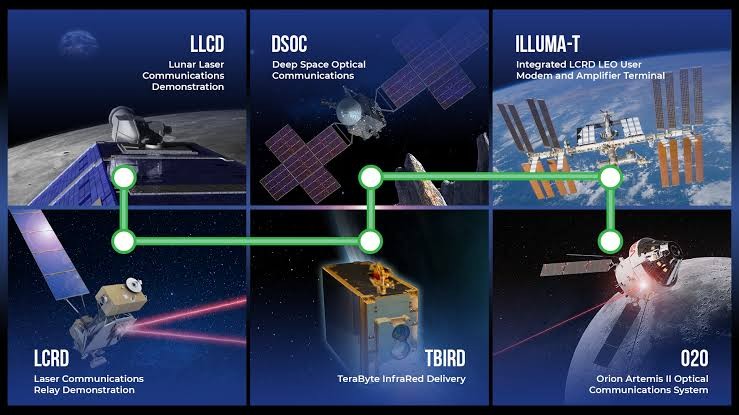
- Free-Space and Inter-Satellite Links: Optical communications extend beyond data centers into space via free-space laser communications, allowing high-capacity, low-interference data links between satellites, deep-space probes, and ground stations.
- Reliability and Energy Efficiency: Optical transceivers offer orders of magnitude higher reliability than legacy electrical or VSCEL transceivers, making them critical for mission-critical, unserviced environments like orbit or deep space.
[More to come ...]
