
The Future of Hydrogen
- [Key Hydrogen Production and Usage Pathways - Royal Society of Chemistry]
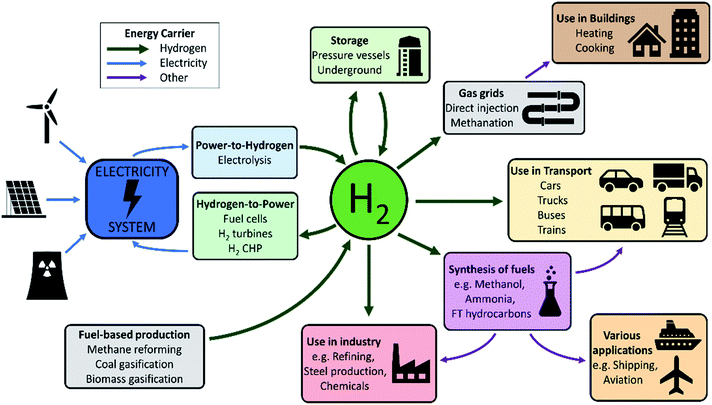
- Overview
The future of hydrogen is characterized by a rapid, policy-driven transition from a traditional fossil-fuel-based industrial feedstock to a cornerstone of global decarbonization, with low-emission production expected to grow from less than 1% in 2024 to roughly 4% by 2030.
While currently dominated by "grey" hydrogen, the sector is investing heavily in "green" (renewables) and "blue" (carbon capture) pathways, with global demand projected to grow six-fold to nearly 600 million tonnes by 2050 to meet net-zero targets.
While some estimates (e.g., DNV) are more conservative, suggesting a 5% share in the 2050 energy mix, most scenarios agree that hydrogen is essential for a 1.5°C scenario, with global demand potentially reaching up to 585 Mtpa by 2050.
1. Key Trends & Future Role (2025–2050):
- Massive Market Growth: The green hydrogen market is experiencing a >31% CAGR (2024-2032), with total hydrogen demand potentially meeting 10-14% of final energy consumption by 2050.
- Decarbonizing Hard-to-Abate Sectors: The primary, long-term future for hydrogen is in sectors that cannot be easily electrified, specifically shipping, aviation, long-haul heavy-duty trucking, and high-temperature industrial heating (steel, cement).
- Shift to Regional Hubs: The industry is moving toward "hydrogen hubs" that co-locate production, storage, and end-use to minimize transportation challenges, such as in the US Gulf Coast, the Middle East, and Europe.
- Geopolitical Energy Shifts: Countries with abundant renewable resources (Australia, Chile, North Africa) are expected to become major exporters, creating a new global energy trade map.
- High Production Costs: Green hydrogen remains significantly more expensive than fossil-based alternatives. While costs are expected to fall 30–50% by 2030, current high capital costs for electrolyzers and renewable energy limit near-term adoption.
- Infrastructure Deficit: Lack of pipelines, storage facilities, and refueling stations is a major constraint. Building dedicated hydrogen infrastructure is slow and expensive.
- Final Investment Decision (FID) Gap: Despite hundreds of project announcements, only a small percentage (around 4% in 2024) have reached a final investment decision, indicating a gap between ambition and implementation.
3. 2030-2050 Projections:
- 2030: Low-emissions hydrogen production could reach 38 Mt (if all projects materialize), with industry (refining, ammonia) switching from grey to green/blue.
- 2050: Green hydrogen is expected to dominate (50-65% of supply), with costs potentially dropping to €1–€1.5/kg in favorable regions.
[More to come ...]
