
Nuclear Fusion
- [Nuclear Fusion - IAEA]
- Overview
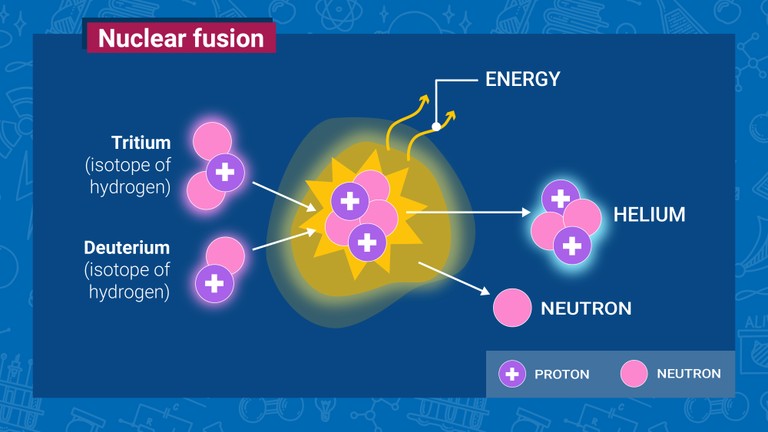
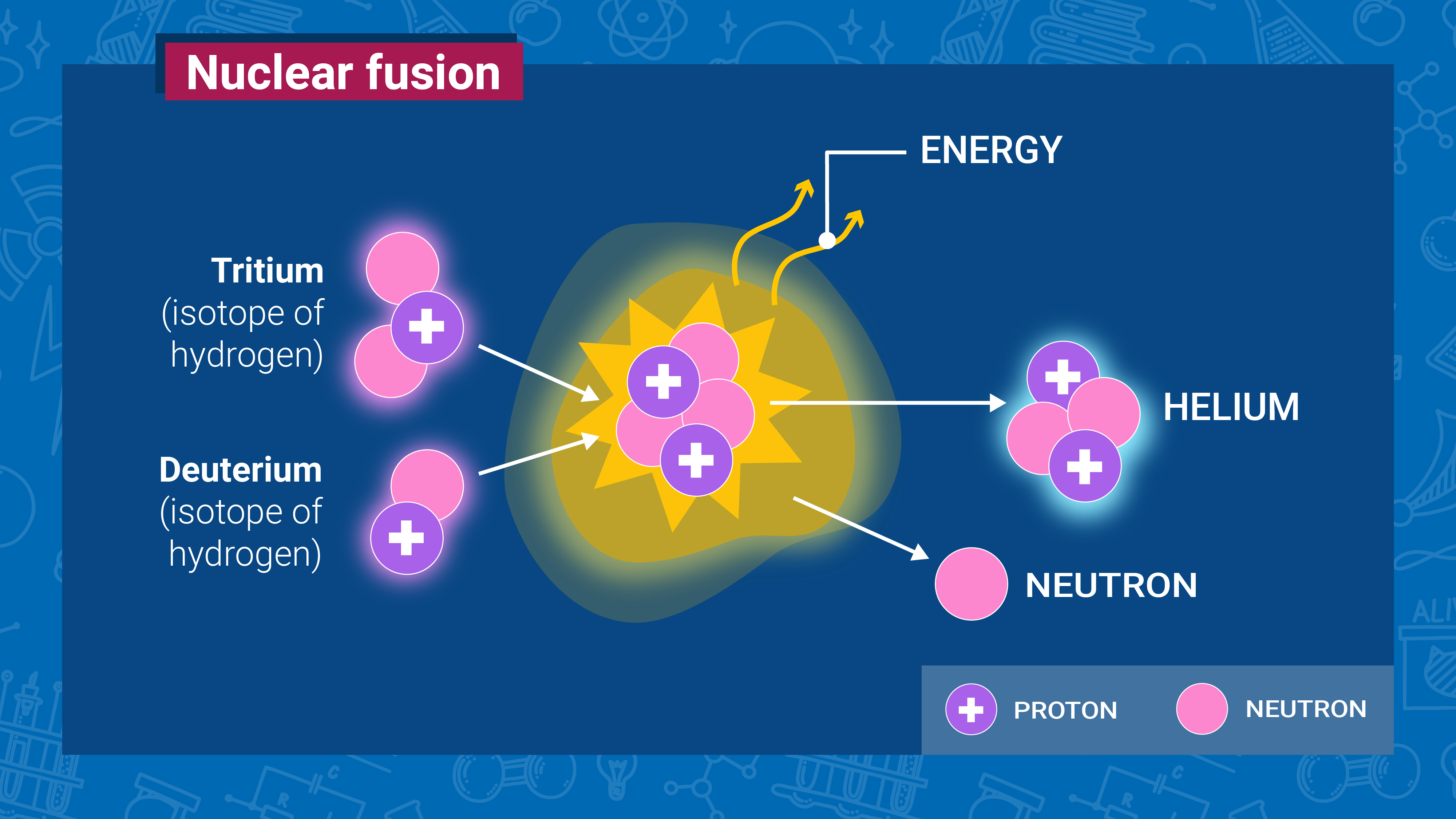
Nuclear fusion is the process where two light atomic nuclei, like hydrogen, combine to form a single, heavier nucleus (e.g., helium), releasing immense amounts of energy, the same process that powers the Sun and stars.
It requires extreme temperatures and pressures to overcome the nuclei's natural repulsion, creating a superheated state of matter called plasma, and it offers a potentially clean, abundant, carbon-free energy source, though it remains challenging to replicate sustainably on Earth.
1. How Nuclear Fusion works:
- Combining nuclei: Instead of splitting atoms (fission), fusion forces them together.
- Overcoming repulsion: High temperatures (millions of degrees Celsius) give nuclei enough energy to overcome their positive charges and get close enough to fuse.
- Energy release: The resulting heavier nucleus has slightly less mass than the original nuclei; this "lost" mass is converted into a huge amount of energy, following Einstein's (𝐸=𝑚𝑐2).
2. Key characteristics:
- Powering stars: Fusion is the fundamental process that generates the light and heat from our Sun and other stars.
- Plasma state: The reaction occurs in plasma, a superheated gas of ions and electrons.
- Fuel: Common fuels involve isotopes of hydrogen (deuterium and tritium).
- Challenges: Recreating the Sun's conditions on Earth requires immense energy input for heating, pressure, and confinement, which scientists are working to achieve in experimental devices like tokamaks.
3. Potential benefits (if harnessed):
- Clean: No greenhouse gases or air pollution.
- Abundant fuel: Deuterium can be extracted from seawater.
- Safer: No risk of meltdown like fission reactors and no long-lived radioactive waste.
Please refer to the following for more information:
- Wikipedia: Nuclear Fusion
- Nuclear Fusion - How the Sun Creates Energy
The Sun generates immense energy through nuclear fusion, specifically the proton-proton chain, where immense gravity in its core forces hydrogen nuclei (protons) to fuse into helium nuclei under extreme heat (15 million °C) and pressure, converting a tiny bit of mass into vast amounts of light and heat energy, which travels to Earth and powers our solar system. It's not "electricity" directly but pure energy (photons, heat) that we later convert to electricity with technologies like solar panels.
In essence, the Sun is a giant nuclear reactor fusing hydrogen into helium, releasing energy; we then harness that energy (light) using technology to make electricity.
1. The Sun's Energy Process (Nuclear Fusion):
- Fuel & Conditions: The Sun's core is primarily hydrogen, existing as super-hot plasma.
- Overcoming Repulsion: Gravity creates immense pressure, forcing hydrogen nuclei (protons) so close they overcome their natural electrical repulsion.
- Fusion Reaction: Four hydrogen nuclei (protons) fuse in a multi-step process (the proton-proton chain) to form one helium nucleus.
- Mass-Energy Conversion: The resulting helium nucleus is slightly less massive than the original four protons; this "missing" mass is converted into energy according to Einstein's (𝐸=𝑚𝑐2).
- Energy Release: This process releases enormous amounts of energy as gamma-ray photons and other particles, providing the Sun's heat and light.
2. From Sun to Electricity on Earth:
- Travel: This energy travels from the Sun's core, eventually reaching Earth as sunlight.
- Conversion: We use solar panels, which contain semiconductors (like silicon) that absorb sunlight and knock electrons loose, creating an electric current that powers devices.
[More to come ...]
