
Powering the Future of Energy
- [Space Solar Panel Energy - Pentagon]
- Overview
The national power infrastructure is undergoing a massive transformation to a decentralized, cleaner, and more resilient "smart grid" to meet surging demand and decarbonization goals.
Key initiatives involve over $20 billion in investments for modernizing transmission, increasing storage capacity, and deploying AI-powered, flexible systems.
This modernization addresses aging infrastructure and improves reliability against extreme weather.
1. Key Aspects of Future Energy Infrastructure:
- Grid Modernization & Expansion: The Department of Energy (.gov) is investing heavily via the Bipartisan Infrastructure Law to expand high-voltage transmission, aiming for 100% clean, reliable, and affordable electricity by 2035.
- Decentralization & Renewables: The grid is shifting from centralized power to varied, distributed sources, with renewable energy expected to account for nearly 45% of global generation by 2030.
- Storage & Flexibility: To manage intermittency, the grid requires increased energy storage and intelligent, automated management systems (smart grids).
- Resilience & Security: Upgrades are focused on securing the infrastructure against cyberattacks and natural disasters, with a focus on testing components in extreme weather conditions.
- Challenges: The industry faces significant hurdles, including rising interconnection costs (from 22/kW to 304/kW between 2000–2022), increased peak demand, and a, need for faster permitting.
2. Future Outlook:
To meet net-zero emissions by 2050, it is estimated that approximately $3.8 trillion in total investment is needed for U.S. grid infrastructure.
The future grid will be more heterogeneous, relying on advanced technologies like digital twins, AI, and improved data center energy management to maintain stability.
- The National Grid Redesign and Modernization
The national grid is undergoing a critical, century-spanning transformation, moving from fossil fuel reliance to intermittent renewable sources, requiring a modernized, flexible, and decentralized infrastructure.
Key changes include implementing digital technologies for two-way communication, managing distributed generation, and enhancing resilience against environmental and cyber threats.
1. Key Aspects of Grid Redesign and Modernization:
- Intermittency Management: To address the fluctuating nature of renewable sources like solar and wind, the grid requires increased energy storage and flexible, rapid-response systems.
- Distributed Generation & Storage: The future grid must interact with decentralized energy sources (e.g., rooftop solar, microgrids) and support two-way power flow between consumers and utilities.
- Smart Technologies: Implementation of smart grids, which use digital automation and advanced, real-time sensing, is essential to manage, predict, and respond to demand variations.
- Enhanced Security: Modernization efforts focus on protecting the grid against cyberattacks, physical attacks, and natural disasters, ensuring reliability.
- Infrastructure Upgrades: The aging, centralized infrastructure requires significant upgrades to, for example, small modular reactors (SMRs) or, in some cases, shifting reliance towards, natural gas for grid stability.
- The Global Energy Transition
The global energy transition is rapidly shifting from a voluntary, market-led endeavor to a state-guided, strategic imperative.
Driven by the need for sustainability, energy security, and industrial competitiveness, governments are moving from "cheerleaders" to active, strategic leaders in managing the transition from fossil fuels to renewable energy.
1. Key Drivers of the Transition:
- Stunning Innovation & Declining Costs: Renewables, particularly wind and solar, are increasingly cost-competitive with, or cheaper than, fossil fuels in many markets.
- Record Capital Investment: Global energy investment in 2025 was expected to exceed $3.3 trillion, with approximately $2.2 trillion aimed at clean energy technologies like renewables, electric vehicles (EVs), and grid infrastructure.
- Regulatory & Policy Shifts: The 2015 Paris Agreement and subsequent net-zero targets (e.g., from the U.S. and China) have solidified long-term goals. Post-pandemic recovery packages, such as the U.S. Inflation Reduction Act and EU initiatives, are actively accelerating the development of sustainable energy systems.
- AI and Data Demand: The rapid expansion of artificial intelligence (AI) and data centers is creating an "electricity surge," placing immense pressure on grids and making reliable, clean energy a key priority.
2. Industry Convergence and New Networks
Over the next decade, previously siloed energy sectors - oil and gas, power utilities, and chemicals - are converging into integrated systems.
- Integration of "Electrons and Molecules": The future energy system will focus on the integrated movement, storage, and creation of both electrons (renewables/batteries) and molecules (hydrogen/biofuels).
- New Business Clusters: Oil and gas companies are pivoting to "energy" companies, investing in solar, hydrogen, and carbon capture.
- Grid Modernization: The energy transition's speed is now dependent on grid capacity, with grid-enhancing technologies (GETs) and storage becoming crucial to handle increased intermittent supply.
3. Future Collaboration and Governance:
Success in this complex, uncertain landscape requires moving beyond purely market-based approaches toward guided, strategic, and often regional coordination.
- Energy Security over Just Sustainability: The transition is now as much about "keeping the lights on" and creating local jobs through green manufacturing as it is about carbon reduction.
- Need for International Action: The 2026 outlook emphasizes that the transition must be a "high-stakes execution test," focused on building infrastructure and supply chains on time rather than just making new, long-term promises.
- Role of Emerging Markets: Countries in the BRICS group now account for over half of global solar generation, highlighting a shift in the center of gravity for clean energy deployment.
- The Future of Renewable Energy
The future of renewable energy is rapidly shifting toward a dominant role, with projections suggesting renewables will meet over 90% of global electricity demand growth between 2025 and 2030, driven by solar, wind, and hydropower.
This transition is essential for combating climate change, reducing CO2 emissions, and securing energy, with investments reaching $2 trillion in 2024.
This shift ensures a sustainable,, and secure energy future while reducing reliance on finite, polluting fossil fuels.
Key trends include:
- Accelerated Growth: The share of renewables in global electricity generation is expected to rise from 32% in 2024 to 43% by 2030.
- Economic & Environmental Benefits: Clean energy investment is outpacing fossil fuels, with potential savings of up to $4.2 trillion annually due to reduced climate impact.
- Overcoming Challenges: Key obstacles include scaling up infrastructure, managing, and the need for significant policy support.
- Technological Advancements: Innovation in energy storage, efficiency, and smart grids is crucial for integrating variable sources like wind and solar.
- The US National Electric Power Infrastructure
The U.S. national electric power infrastructure is a massive, complex network critical to the country's economic stability and security.
Often described as the "largest machine in the world," it relies on aging components that face increasing pressure from rising demand and climate-driven extreme weather.
(A) Key Components of the U.S. Electric Grid:
1. Generating Units: More than 9,200 electric generating units.
2. Generating Capacity: Over 1 million megawatts.
3. Transmission Lines: More than 600,000 miles of backbone transmission lines.
- Includes 240,000 miles of high-voltage lines (≥ 230 Kilovolts).
4. Distribution Lines: Approximately 5.5 million miles of local low-voltage lines.
5. Connectivity: Millions of distribution transformers connect thousands of power plants to 145 million+ customers.
(B) Critical Infrastructure Challenges:
1. Aging Systems: Much of the grid was built 50–70 years ago, exceeding its intended 50-year lifespan.
- 70% of transmission and distribution lines are well into the second half of their expected life.
- Large power transformers, which handle 90% of U.S. electricity flow, have an average age of over 40 years.
2. Reliability Risks: Outages are becoming more frequent as the aging infrastructure struggles with modern energy demands and extreme weather events.
3. Modernization Needs: Estimates suggest hundreds of billions of dollars in investment are required over the coming decades to overhaul the grid for renewable energy and improved security.
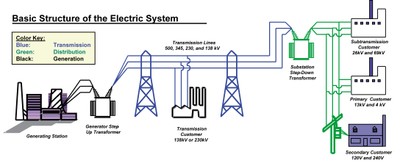
- (The Basic Structure of the Electric System - Iowa State University)
- The Aging US Power Grid: Navigating Toward Modernization
The aging U.S. power grid is a critical infrastructure initiative aimed at replacing, strengthening, and digitizing electricity delivery systems, with over 70% of lines being more than 25 years old.
Modernization focuses on deploying "smart grid" technologies - such as sensors, AI-driven monitoring, and automation - to enhance resilience against extreme weather, incorporate renewable energy, and improve security, often funded by initiatives like the Bipartisan Infrastructure Law and GRIP Program.
Modernization is essential to transition to a, secure, and clean energy future, transforming the grid into a flexible, two-way, and responsive system.
Key components of this modernization effort include:
- Smart Grid Technologies: Utilizing advanced metering infrastructure (AMI), automated, sensors, and phasor measurement units (PMUs) for real-time monitoring to improve outage response by up to 30%.
- Grid Enhancing Technologies (GETs): Implementing dynamic line ratings (DLR) and advanced conductors to increase transmission capacity by 40% without building new, extensive, and costly infrastructure.
- Resilience and Distributed Energy Resources (DERs): Integrating localized solar, battery storage, and microgrids to reduce grid strain and enhance reliability for critical facilities.
- Infrastructure Hardening: Upgrading, replacing, and, in some cases, undergrounding lines to mitigate risks from wildfires and extreme weather.
- Digitalization and AI: Leveraging artificial intelligence for predictive maintenance to reduce operational costs by 43–56% and minimize repair crew visits.
- Policy and Funding: Leveraging billions in federal funding, such as GRIP grants and Department of Energy (DOE) programs, alongside public-private partnerships to accelerate upgrades.
- Understanding Traditional Electric Power Grid
A traditional electric power grid is a centralized, one-way system that generates electricity at large power plants (using fossil fuels or hydro), transports it over high-voltage transmission lines, and distributes it to consumers. It requires an instantaneous, precise balance between generation and demand because large-scale electricity storage is limited.
The traditional grid is increasingly facing challenges with aging infrastructure and the need to integrate decentralized, small-scale power generation.
1. Key Characteristics of the Traditional Grid:
- Centralized Generation: Large power stations, often located far from population centers, generate the bulk of electricity.
- One-Way Power Flow: Electricity travels in a single direction from the central power plant to the end consumer.
- Transmission & Distribution: High-voltage (HV) lines transfer power over long distances, with transformers stepping down voltage at substations for distribution to homes and businesses.
- Reliability Mechanism: To maintain stability, the system relies on high-inertia turbines and carefully matched generation to load, as immediate, large-scale storage is not typically available.
- Infrastructure: The system is an interconnected network of generators, substations, and lines designed to provide, in many cases, reliable, 24/7 power.
- The Synergy between AI and Renewable Energy
The rapid expansion of artificial intelligence (AI) has significantly increased energy demand from data centres, which the International Energy Agency (IEA) projects will double by 2026, requiring power equivalent to the entire country of Japan.
While this surge challenges sustainability goals - with some tech companies experiencing increased emissions - AI is also being used to optimize renewable energy solutions, such as solar, to meet this demand.
The synergy between AI and renewable energy, particularly solar, provides a path to meet the growing demand for computing power while supporting global decarbonization goals.
1. AI’s Impact on Energy Demand:
- Surging Demand: Data centers, AI, and cryptocurrency are projected to double their electricity consumption by 2026, driven largely by rapid advancements in AI.
- Emissions Growth: Despite corporate commitments to carbon neutrality, the intense energy needs of AI have caused emissions for major tech companies to rise.
- Scale of Usage: Global data center electricity consumption could reach over 1,000 terawatt-hours (TWh) by 2026, a significant increase from 460 TWh in 2022.
2. AI as a Solution for Renewable Energy
AI is being integrated into the energy sector to manage the intermittency of renewable sources and enhance efficiency:
- Solar Investment: Power sector investment in solar photovoltaic (PV) technology is projected to exceed $500 billion in 2024, surpassing all other electricity generation sources combined.
- AI Applications: Over 100 vendors are integrating AI into energy products, driving a $13 billion investment in over 50 potential applications.
- Predictive Maintenance: AI-driven models can increase solar productivity by 25%, reduce breakdowns by 70%, and lower maintenance costs by 25%.
- Grid Optimization: AI enhances battery storage by managing when to store and release energy, transforming solar into a more reliable "always-on" power source.
3. Overcoming Solar Challenges:
AI helps address the limitations of solar energy, such as its dependence on weather conditions:
- Weather Forecasting: AI algorithms use real-time meteorological data and cloud-imaging technology to maximize solar output.
- Managing Intermittency: AI improves grid management, allowing for better integration of solar energy, even during extreme weather events like heatwaves or sandstorms.
- Efficiency Gains: AI improves the efficiency of solar panels by identifying issues like dirt accumulation or shading.
[More to come ...]
