
Cellular Networks, Base Stations, 5G RAN and Beyond
- (Simplified Overview of a Mobile Network - Medium Technology)
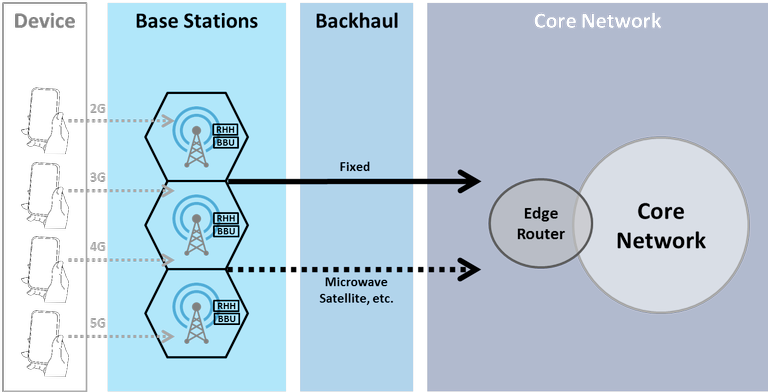
- Overview
Cellular networks use base stations within the Radio Access Network (RAN) to connect user devices to the core network.
The transition to 5G and beyond involves key changes like network densification, new spectrum usage, and virtualized architectures to deliver faster speeds, lower latency, and support massive connectivity.
A. Cellular Networks and Base Stations:
A cellular network is composed of geographically defined "cells", each served by a base station (also known as a cell site, eNodeB in 4G, or gNodeB in 5G). The base station facilitates wireless communication between user equipment (UE) and the network's core, which then connects to other networks like the public switched telephone network (PSTN) or the internet.
Base stations comprise two main parts:
- Active Antenna Unit (AAU): The component that transmits and receives radio signals over the air.
- Baseband Unit (BBU): The digital processing part that manages data and network resource allocation.
B. The Role of the Radio Access Network (RAN):
The RAN is the essential part of the network infrastructure that manages the radio link between user devices and the core network. Historically, the RAN has been a significant cost factor for network operators.
The evolution to 5G has driven new RAN architectures:
- Traditional RAN: Each cell site contained the full base station equipment (radio, baseband, power, cooling).
- Centralized/Cloud RAN (C-RAN): This architecture separates the radio functions (Remote Radio Heads or RRHs) from the baseband units (BBUs), centralizing the BBUs in data centers. This reduces equipment duplication and operational costs.
- Open RAN (O-RAN): An industry initiative promoting open interfaces and standard hardware, allowing operators more flexibility in choosing vendor components and fostering innovation.
C. 5G RAN and Beyond:
The fifth generation of networks leverages several new technologies requiring changes in the RAN and base station deployment:
- Spectrum Usage: 5G uses a wider range of frequencies, from low-band (wide coverage, similar to 4G) to mid-band (balance of speed and coverage) and high-band/millimeter-wave (mmWave) which offers extremely high speeds but has a very short range, requiring many more base stations for coverage.
- Network Densification: To achieve widespread coverage, especially with mmWave, a significantly higher density of base stations, including small cells on urban infrastructure like lampposts, is required.
- AI and Automation: "Beyond 5G" (or 5G-Advanced) networks are integrating AI and intent-based automation to enhance energy efficiency, manage mobility, and optimize network performance.
- New Architectures: Technologies like network slicing (creating isolated virtual networks for specific services) and Multi-access Edge Computing (MEC) are key for 5G and future networks, enabling applications like autonomous vehicles and industrial automation.
- Energy Efficiency: A major challenge is that 5G base stations consume significantly more power than 4G, leading to industry focus on AI-driven energy-saving features for 5G-Advanced and 6G.
- How A 5G and Beyond Network Works
A 5G and beyond cellular network works by dividing areas into small cells with base stations, using radio waves for device communication, and cleverly reusing frequencies across non-adjacent cells to boost capacity, all managed by intelligent software for seamless handoffs as users move, enabling ultra-fast, low-latency connectivity for more devices, connecting everything from phones to cars and industrial sensors via enhanced "small cells," network slicing, and higher-frequency millimeter waves for greater bandwidth.
1. Core Principles:
- Cellular Architecture: A large area is broken into smaller "cells," each with a local base station (cell tower or small cell) connecting devices via radio waves.
- Frequency Reuse: Limited radio frequencies are reused in different, non-neighboring cells, drastically increasing network capacity without interference.
- Connectivity Backbone: Cell sites link to core network switches, connecting to the internet and public phone networks, often using high-speed fiber.
- Mobility (Handoff): When you move, the network seamlessly transfers your connection from one cell to the next without dropping the call or data stream.
2. 5G & Beyond Enhancements:
- Small Cells: Dense deployment of low-power nodes (small cells) on poles or buildings provides localized coverage and capacity, especially in cities.
- Millimeter Waves (mmWave): Utilizes higher frequencies for massive data capacity, though these waves have shorter range and struggle with obstacles, requiring more small cells.
- Lower Latency: Reduced response times (milliseconds) support real-time applications like autonomous vehicles and remote surgery.
- Massive IoT Support: Handles vastly more connected devices (sensors, machines) for the Internet of Things.
- Network Slicing: Creates multiple virtual networks on shared physical infrastructure, tailored for specific needs (e.g., one slice for critical services, another for general browsing).
- Edge Computing: Brings data processing closer to users for faster response times.
[More to come ...]
